Distinguishing rare from common minting defects on ten-cent coins requires understanding the production cycles of the U.S. Mint.
Most changes in coin appearance found in circulation are classified as mechanical damage or die wear, possessing no numismatic value.
The dime minting process involves high-speed press strikes on planchets fed from automatic feeders.
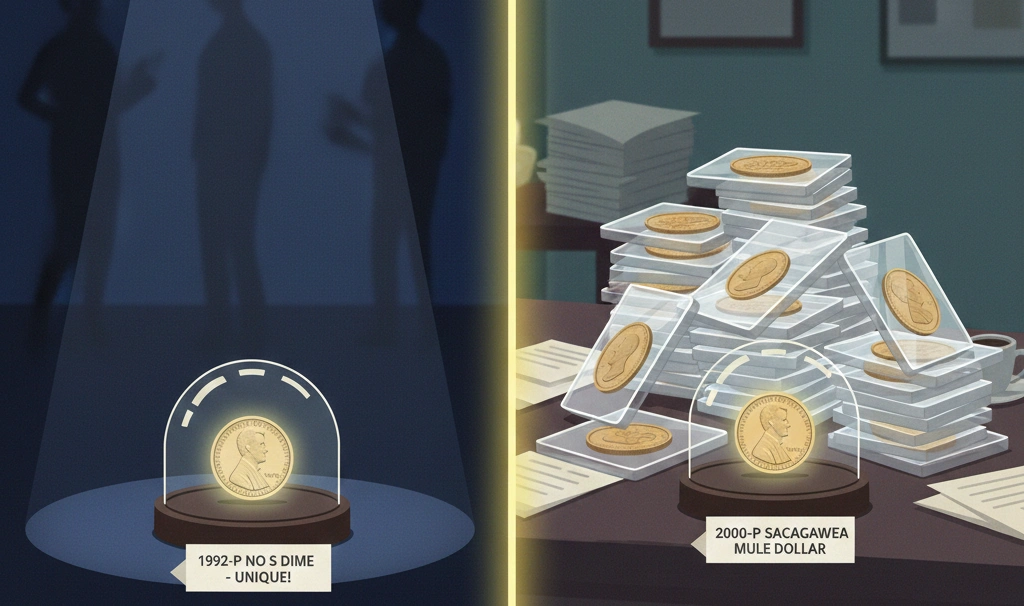
You can see that the dime errors list with pictures often arises in three stages: die manufacturing, planchet preparation, and the actual striking process.
Stage of Origin | Error Type | Rarity Status |
Die Manufacturing | Doubled Die | High |
Planchet Preparation | Wrong Alloy / Weight | Medium |
Striking Process | Off-center Strike | Low to High |
Absence of Mint Mark (No S Proof)
The most valuable category of errors among modern dimes includes Proof quality coins issued without the San Francisco ("S") mint mark.
These specimens were struck for special collector sets, entering them as a result of using dies intended for Philadelphia.
1968 No S Roosevelt Dime: The first instance of omitting a mint mark on Proof coins.
1970 No S Roosevelt Dime: Several hundred specimens discovered, making them highly sought after.
1975 No S Roosevelt Dime: The rarest coin of the series, with the confirmed quantity being only 2 specimens.
1982 No S Roosevelt Dime: The only instance of missing a mark on business strike coins.
In 2019, a 1975 "No S" dime was sold at a Heritage Auctions event for 456,000 US dollars.
A 1982 dime without the "P" mark (Philadelphia) is valued at 100–300 dollars depending on condition, as its mintage is estimated at 10,000 – 15,000 pieces.
Wear and Grease-Filled Die Errors
Most "blank" areas found on coins are not rare errors, being the result of a die clogged with grease (Grease Filled Die).
Upon thick grease entering die recesses, relief details such as date digits or "LIBERTY" letters are not struck.
Such specimens are encountered in multi-million mintages and possess no added value above the face value.
Also among common defects are die cracks appearing as thin raised lines on the coin surface.
Exceptions include large die breaks affecting more than 25% of the coin area, called "CUD" errors.
Doubled Die
True doubling arises at the working die creation stage, passing an identical defect to every struck coin.
It is necessary to distinguish "Doubled Die" from "Machine Doubling" (mechanical doubling) occurring during press play at the moment of impact.
Feature | Doubled Die (Rare) | Machine Doubling (Common) |
Relief | Clear, rounded doubling | Flat, step-like doubling |
Contour | Separation of serif ends | Cutting off part of the image |
Repeatability | Identical on all coins | Unique for every strike |
The record price for a 1964 Roosevelt Dime with a doubled die reverse (DDR) in MS 67 grade is approximately 3,500 dollars.
The average annual value growth for certified "Doubled Die" dimes is 4.2%, demonstrating resilience to market fluctuations.
Planchet Errors and Wrong Metals
The value of a planchet error is determined by the rarity of the denomination and material combination.
Roosevelt dimes struck on cent planchets (copper) or on silver planchets from previous years (after 1964) possess high market value.
1965 Silver Roosevelt Dime: A transitional error occurring when a 1964 silver planchet entered 1965 production. The price reaches 7,000 – 9,000 dollars.
Dime on Penny Planchet: A smaller coin having a copper color and clipped inscription edges. Valued at 300–600 dollars.
The value of such errors falls by 5–7% in the presence of circulation traces, as surface damage complicates alloy verification without chemical analysis.
Off-Center Strikes and Their Evaluation
A minting displacement is considered valuable only while retaining the full date and mint mark on the planchet.
The displacement percentage directly correlates with price up to a certain limit, after which the coin loses recognizability.
Displacement (%) | Estimated Value (USD) | Features |
5–10% | $5 – $15 | Frequently found in circulation |
25–40% | $50 – $120 | Date must be visible |
50% | $150 – $300 | Maximum visual value |
>75% | $40 – $80 | Part of the date usually missing |
Broadstrikes and Edge Errors
Coins struck outside the collar ring possess a larger diameter and lack edge reeding.
For a Roosevelt dime to be recognized as a rare "Broadstrike," all design details must be fully visible on the planchet.
If part of the image is missing, the coin is classified as an off-center strike requiring a different evaluation system.
The average price for Broadstrike Roosevelt dimes from 1970–1990 is 15–30 dollars per specimen in Uncirculated condition.

Authenticity Verification
Verification of rare errors excludes using subjective methods, relying on instrumental control.
Weighing: The standard weight of a modern dime is 2.268 g. A deviation of more than 0.15 g without visible wear indicates a planchet error.
Diameter Measurement: Using a micrometer with the free coin identifier app allows for detecting a Broadstrike or the use of a planchet from a foreign order.
Spectral Analysis: Applied for verifying 1965 silver errors and "No S" variants.
Microscopy: 40x magnification is necessary for distinguishing "Doubled Die" from "Machine Doubling" by characteristic metal layering lines.
Market Statistics and Investment Risks
The market for coins with minting errors is characterized by low liquidity compared to standard rare dates.
The percentage of coins failing certification due to mechanical damage (Post-Mint Damage) mistaken by beginners for errors is up to 75%.
Investing in "No S" type errors requires a PCGS or coin value app screenshot, as counterfeits made by removing the "S" mark are common.
The annual number of new rare "Doubled Die" finds in circulation falls by 12% due to the automation of bank sorting centers.
Defect Type | Frequency of Occurrence | Liquidity | Entry Threshold (USD) |
Die Chips | Very high | Very low | $1 |
20% Off-center | Medium | Medium | $40 |
No S Proof | Extremely low | Very high | $1,000+ |
Wrong Planchet | Low | High | $300 |
Conclusion
Distinguishing rare dime errors from common production flaws is based on identifying the stage of the defect's origin.
Statistical data confirm that the greatest value is possessed by coins with systemic die errors (No S, Doubled Die) and gross planchet feeding violations.
Maintaining the investment attractiveness of a collection requires mandatory expert evaluation excluding the acceptance of mechanical damage as rare numismatic objects.